

AML Screening Software in Australia: Myths vs Reality
.svg)
Australia relies heavily on screening to keep bad actors out of the financial system, yet most people misunderstand what AML screening software actually does.
Introduction: Why Screening Is Often Misunderstood
AML screening is one of the most widely used tools in compliance, yet also one of the most misunderstood. Talk to five different banks in Australia and you will hear five different definitions. Some believe screening is just a simple name check. Others think it happens only during onboarding. Some believe screening alone can detect sophisticated crimes.
The truth sits somewhere in between.
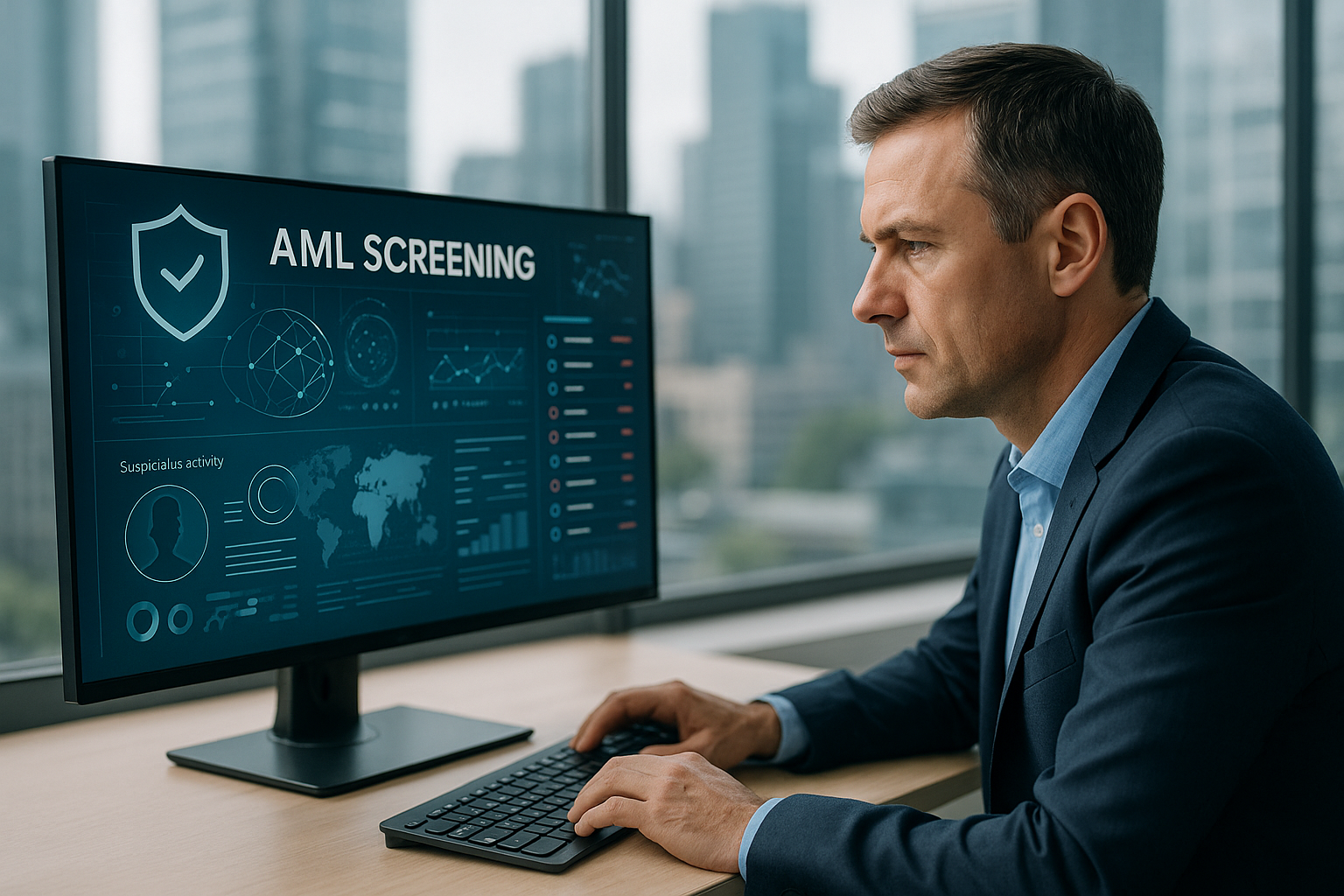
In practice, AML screening software plays a crucial gatekeeping role across Australia’s financial ecosystem. It checks whether individuals or entities appear in sanctions lists, PEP databases, negative news sources, or law enforcement records. It alerts banks if customers require enhanced due diligence or closer monitoring.
But while screening software is essential, many myths shape how it is selected, implemented, and evaluated. Some of these myths lead institutions to overspend. Others cause them to overlook critical risks.
This blog separates myth from reality through an Australian lens so banks can make more informed decisions when choosing and using AML screening tools.

Myth 1: Screening Is Only About Checking Names
The Myth
Many institutions think screening is limited to matching customer names against sanctions and PEP lists.
The Reality
Modern screening is far more complex. It evaluates:
- Names
- Addresses
- ID numbers
- Date of birth
- Business associations
- Related parties
- Geography
- Corporate hierarchies
In Australia, screening must also cover:
- DFAT sanctions lists
- AUSTRAC expectations on ongoing due diligence
- Politically exposed persons specific to the region
- Adverse media from credible local sources
True screening software performs identity resolution, fuzzy matching, phonetic matching, transliteration, and context interpretation.
It helps analysts interpret whether a match is genuine, a near miss, or a false positive.
In other words, screening is identity intelligence, not just name matching.
Myth 2: All Screening Software Performs the Same Way
The Myth
If all vendors use sanctions lists and PEP databases, the output should be similar.
The Reality
Two screening platforms can deliver dramatically different results even if they use the same source lists.
What sets screening tools apart is the engine behind the list:
- Quality of fuzzy matching algorithms
- Ability to detect transliteration variations
- Handling of abbreviations and cultural naming patterns
- Matching thresholds
- Entity resolution capabilities
- Ability to identify linked entities or corporate structures
- Context scoring
- Language models for global names
Australia’s multicultural population makes precise matching even more critical. A name like Nguyen, Patel, Singh, or Haddad can generate thousands of potential matches if the engine is not built for linguistic nuance.
The best screening software minimises noise while maintaining strong coverage.
The worst creates thousands of false positives that overwhelm analysts.
Myth 3: Screening Happens Only at Onboarding
The Myth
Many believe screening is a single event that happens when a customer first opens an account.
The Reality
Australian regulations expect continuous screening, not one-time checks.
According to AUSTRAC’s guidance on ongoing due diligence, screening must occur:
- At onboarding
- On a scheduled frequency
- When a customer’s profile changes
- When new information becomes available
- When a transaction triggers risk concerns
Modern screening software therefore includes:
- Batch rescreening
- Event-driven screening
- Ongoing monitoring modules
- Trigger-based screening tied to high-risk behaviours
Criminals evolve, and their risk profile evolves.
Screening must evolve with them.
Myth 4: Screening Alone Can Detect Money Laundering
The Myth
Some smaller institutions believe strong screening means strong AML.
The Reality
Screening is essential, but it is not designed to detect behaviours like:
- Structuring
- Layering
- Mule networks
- Rapid pass-through accounts
- Cross-border laundering
- Account takeover
- Syndicated fraud
- High-velocity payments through NPP
Screening identifies who you are dealing with.
Monitoring identifies what they are doing.
Both are needed.
Neither replaces the other.
Myth 5: Screening Tools Do Not Require Localisation for Australia
The Myth
Global vendors often claim their lists and engines work the same in every country.
The Reality
Australia has unique requirements:
- DFAT Consolidated List
- Australia-specific PEP classifications
- Regionally relevant negative news
- APRA CPS 230 expectations on third-party resilience
- Local language and cultural naming patterns
- Australian corporate structures and ABN linkages
A tool that works in the US or EU may not perform accurately in Australia.
This is why localisation is essential in screening software.
Myth 6: False Positives Are Only a Technical Problem
The Myth
Banks assume high false positives are the fault of the algorithm alone.
The Reality
False positives often come from:
- Poor data quality
- Duplicate customer records
- Missing identifiers
- Abbreviated names
- Unstructured onboarding forms
- Inconsistent KYC fields
- Old customer information
Screening amplifies whatever data it receives.
If data is inconsistent, messy, or incomplete, no screening engine can perform well.
This is why many Australian banks are now focusing on data remediation before software upgrades.
Myth 7: Screening Software Does Not Need Explainability
The Myth
Some assume explainability matters only for advanced AI systems like transaction monitoring.
The Reality
Even screening requires transparency.
Regulators want to know:
- Why a match was generated
- What fields contributed to the match
- What similarity percentage was used
- Whether a phonetic or fuzzy match was triggered
- Why an analyst decided a match was false or true
Without explainability, screening becomes a black box, which is unacceptable for audit and governance.
Myth 8: Screening Software Is Only a Compliance Tool
The Myth
Non-compliance teams often view screening as a back-office necessity.
The Reality
Screening impacts:
- Customer onboarding experience
- Product journeys
- Fintech partnership integrations
- Instant payments
- Cross-border remittances
- Digital identity workflows
Slow or inaccurate screening can increase drop-offs, limit product expansion, and delay partnerships.
For modern banks and fintechs, screening is becoming a customer experience tool, not just a compliance one.
Myth 9: Human Review Will Always Be Slow
The Myth
Many believe analysts will always struggle with screening queues.
The Reality
Human speed improves dramatically when the right context is available.
This is where intelligent screening platforms stand out.
The best systems provide:
- Ranked match scores
- Reason codes
- Linked entities
- Associated addresses
- Known aliases
- Negative news summaries
- Confidence indicators
- Visual match explanations
This reduces analyst fatigue and increases decision accuracy.
Myth 10: All Vendors Update Lists at the Same Frequency
The Myth
Most assume sanctions lists and PEP data update automatically everywhere.
The Reality
Update frequency varies dramatically across vendors.
Some update daily.
Some weekly.
Some monthly.
And some require manual refresh.
In fast-moving geopolitical environments, outdated sanctions lists expose institutions to enormous risk.
The speed and reliability of updates matter as much as list accuracy.
A Fresh Look at Vendors: What Actually Matters
Now that we have separated myth from reality, here are the factors Australian banks should evaluate when selecting AML screening software.
1. Quality of the matching engine
Fuzzy logic, phonetic logic, name variation modelling, and transliteration support make or break screening accuracy.
2. Localised content
Coverage of DFAT, Australia-specific PEPs, and local negative news.
3. Explainability and transparency
Clear match reasons, similarity scoring, and audit visibility.
4. Operational fit
Analyst workflows, bulk rescreening, TAT for decisions, and queue management.
5. Resilience and APRA alignment
CPS 230 requires strong third-party controls and operational continuity.
6. Integration depth
Core banking, onboarding systems, digital apps, and partner ecosystems.
7. Data quality tolerance
Engines that perform well even with incomplete or imperfect KYC data.
8. Long-term adaptability
Technology should evolve with regulatory and criminal changes, not stay static.
How Tookitaki Approaches Screening Differently
Tookitaki’s approach to AML screening focuses on clarity, precision, and operational confidence, ensuring that institutions can make fast, accurate decisions without drowning in noise.
1. A Matching Engine Built for Real-World Names
FinCense incorporates advanced phonetic, fuzzy, and cultural name-matching logic.
This helps Australian institutions screen accurately across multicultural naming patterns.
2. Clear, Analyst-Friendly Explanations
Every potential match comes with structured evidence, similarity scoring, and clear reasoning so analysts understand exactly why a name was flagged.
3. High-Quality, Continuously Refreshed Data Sources
Tookitaki maintains up-to-date sanctions, PEP, and negative news intelligence, allowing institutions to rely on accurate and timely results.
4. Resilience and Regulatory Alignment
FinCense is built with strong operational continuity controls, supporting APRA’s expectations for vendor resilience and secure third-party technology.
5. Scalable for Institutions of All Sizes
From large banks to community-owned institutions like Regional Australia Bank, the platform adapts easily to different volumes, workflows, and operational needs.
This is AML screening designed for accuracy, transparency, and analyst confidence, without adding operational friction.
Conclusion: Screening Is Evolving, and So Should the Tools
AML screening in Australia is no longer a simple name check.
It is a sophisticated, fast-moving discipline that demands intelligence, context, localisation, and explainability.
Banks and fintechs that recognise the myths early can avoid costly mistakes and choose technology that supports long-term compliance and customer experience.
The next generation of screening software will not just detect matches.
It will interpret identities, understand context, and assist investigators in making confident decisions at speed.
Screening is no longer just a control.
It is the first line of intelligence in the fight against financial crime.
Experience the most intelligent AML and fraud prevention platform
Experience the most intelligent AML and fraud prevention platform
Experience the most intelligent AML and fraud prevention platform
Top AML Scenarios in ASEAN
The Role of AML Software in Compliance
The Role of AML Software in Compliance

We’ve received your details and our team will be in touch shortly.
Ready to Streamline Your Anti-Financial Crime Compliance?
Our Thought Leadership Guides
From Obligation to Advantage: Rethinking AML Compliance for Modern Financial Institutions
AML compliance is no longer a back-office obligation. It is now a frontline risk discipline.
Introduction
Financial institutions today operate in a fast-moving, digitally connected ecosystem where money moves instantly across accounts, platforms, and borders. While this transformation improves access and efficiency, it also creates new opportunities for financial crime. Regulators, customers, and stakeholders now expect institutions to identify suspicious activity early, respond quickly, and maintain strong governance.
This shift has elevated AML compliance from a regulatory requirement to a strategic priority. Banks and fintechs must move beyond manual processes and fragmented systems to implement intelligent, scalable compliance frameworks.
In markets like the Philippines, where digital payments, cross-border remittances, and fintech innovation continue to grow rapidly, AML compliance has become even more critical. Institutions must manage increasing transaction volumes while maintaining visibility into customer behaviour and risk exposure.
Modern AML compliance solutions address this challenge by combining transaction monitoring, screening, risk assessment, and case management into a unified framework. This integrated approach enables financial institutions to detect suspicious activity, reduce false positives, and strengthen regulatory alignment.
The Expanding Scope of AML Compliance
AML compliance today covers far more than transaction monitoring. Financial institutions must manage risk across the entire customer lifecycle.
This includes:
- Customer onboarding and due diligence
- Ongoing monitoring of transactions
- Sanctions and watchlist screening
- PEP screening and adverse media checks
- Risk assessment and scoring
- Investigation and case management
- Suspicious transaction reporting
Each component plays a role in identifying and managing financial crime risk.
Modern AML compliance software integrates these functions into a unified platform. This reduces operational silos and improves decision-making.
AML Compliance Challenges in the Philippines
Banks and fintechs in the Philippines face unique compliance challenges due to rapid financial digitisation.
High Transaction Volumes
Digital banking and instant payment systems generate large volumes of transactions. Monitoring these efficiently requires scalable AML compliance solutions.
Cross-Border Remittance Risk
The Philippines is one of the world’s largest remittance markets. Cross-border transactions increase exposure to money laundering risks.
Rapid Fintech Growth
Fintech innovation accelerates onboarding and payment processing. Compliance systems must adapt to fast customer growth.
Evolving Financial Crime Techniques
Financial crime networks increasingly combine fraud and laundering. AML compliance systems must detect complex patterns.
Regulatory Expectations
Regulators expect risk-based AML compliance frameworks with strong audit trails and reporting.
These factors highlight the need for modern AML compliance platforms.
Why Traditional AML Compliance Approaches Fall Short
Legacy AML compliance systems often rely on static rules and manual workflows. These approaches struggle in modern financial environments.
Common limitations include:
- Excessive false positives
- Manual investigations
- Limited behavioural analysis
- Delayed detection
- Fragmented workflows
- Poor scalability
These issues increase operational costs and reduce compliance effectiveness.
Modern AML compliance software addresses these challenges through automation, AI-driven analytics, and real-time monitoring.
What Modern AML Compliance Solutions Deliver
Next-generation AML compliance platforms provide intelligent risk detection and operational efficiency.
Key capabilities include:
Real-Time Transaction Monitoring
Modern AML compliance systems analyse transactions as they occur. This enables early detection of suspicious activity.
Real-time monitoring helps identify:
- Rapid fund movement
- Structuring patterns
- Mule account activity
- Cross-border laundering
- Suspicious payment flows
Early detection improves compliance outcomes.
Risk-Based Customer Monitoring
Modern AML compliance software applies risk-based models to monitor customers continuously.
Risk scoring considers:
- Customer profile
- Transaction behaviour
- Geographic exposure
- Network relationships
- Historical activity
This helps prioritise high-risk customers.
Integrated Screening Capabilities
AML compliance solutions include screening tools for:
- Sanctions lists
- PEP databases
- Watchlists
- Adverse media
Integrated screening ensures consistent risk evaluation.
Automated Case Management
AML compliance requires structured investigations. Case management tools streamline workflows.
Capabilities include:
- Alert-to-case conversion
- Investigator assignment
- Evidence collection
- Documentation
- Escalation workflows
Automation improves investigation efficiency.
AI-Driven Detection
Artificial intelligence enhances AML compliance by identifying complex patterns.
AI models:
- Reduce false positives
- Detect anomalies
- Identify emerging typologies
- Improve alert prioritisation
These capabilities improve detection accuracy.

AML Compliance for Banks and Fintechs
Banks and fintechs have different operating models, but both face increasing financial crime risk and regulatory pressure.
Banks typically need:
- High-volume transaction monitoring
- Corporate and retail risk assessment
- Cross-border payment oversight
- Strong governance and reporting controls
Fintechs often need:
- Fast onboarding controls
- Real-time payment risk detection
- Scalable compliance workflows
- Digital-first monitoring and screening
AML compliance platforms must support both environments without compromising efficiency or coverage.
Technology Architecture for Modern AML Compliance
Modern AML compliance software is built on scalable, integrated architecture.
Key components include:
- Real-time analytics engines
- AI-driven risk scoring models
- Screening modules
- Case management workflows
- Regulatory reporting tools
Cloud-native deployment allows institutions to process larger transaction volumes while maintaining performance. This architecture supports growth without forcing institutions to rebuild compliance systems every time scale increases.
Why Integration Matters More Than Ever
One of the biggest weaknesses in older AML environments is fragmentation.
Monitoring operates on one system. Screening is managed elsewhere. Investigations happen through email, spreadsheets, or disconnected case tools. This creates delays, duplication, and information gaps.
Integrated AML compliance software connects these functions. Screening results can influence monitoring thresholds. Investigation outcomes can update customer risk profiles. Risk scores can guide case prioritisation.
This integration improves operational efficiency and strengthens control quality across the compliance lifecycle.
AML Compliance Metrics That Matter
Modern AML compliance platforms must do more than exist. They must perform.
The most meaningful outcomes include:
- Lower false positives
- Faster alert reviews
- Higher quality alerts
- Improved investigation consistency
- Better regulatory defensibility
In practice, intelligent AML platforms have helped institutions achieve significant reductions in false positives, faster alert disposition, and stronger quality of investigative outcomes.
These are the metrics that matter because they show whether compliance is improving in substance, not just in process.
How Tookitaki FinCense Supports Modern AML Compliance
Tookitaki’s FinCense is built for this new era of AML compliance. As an AI-native platform, it brings together transaction monitoring, screening, customer risk scoring, and case management into a single environment, helping banks and fintechs strengthen compliance while reducing false positives and improving investigation efficiency.
Positioned as the Trust Layer, FinCense is designed to support real-time prevention and end-to-end AML compliance across high-volume, fast-moving financial ecosystems.
The Role of AI in AML Compliance
AI is transforming AML compliance by enabling adaptive risk detection.
AI capabilities include:
- Behavioural analytics
- Network analysis
- Pattern recognition
- Alert prioritisation
AI-driven AML compliance improves efficiency while reducing false positives. However, intelligence alone is not enough. Compliance teams must also be able to understand and explain why alerts were triggered.
That is why modern AML platforms combine machine learning with transparent risk-scoring frameworks and structured workflows.
Strengthening Regulatory Confidence
Regulators increasingly expect financial institutions to demonstrate strong governance and transparent controls.
AML compliance software helps institutions maintain:
- Structured audit trails
- Clear documentation of alert decisions
- Timely suspicious transaction reporting
- Consistent investigation workflows
These capabilities strengthen regulatory confidence because they show not just that a control exists, but that it is functioning effectively.
Frequently Asked Questions About AML Compliance
What is AML compliance?
AML compliance refers to the policies, controls, and systems financial institutions use to detect and prevent money laundering and related financial crime.
Why is AML compliance important?
AML compliance helps institutions protect the financial system, detect suspicious activity, meet regulatory requirements, and reduce exposure to financial crime risk.
What does AML compliance software do?
AML compliance software helps institutions monitor transactions, screen customers, assess risk, manage investigations, and prepare regulatory reports in a structured and scalable way.
Who needs AML compliance solutions?
Banks, fintechs, payment providers, remittance firms, and other regulated financial institutions all require AML compliance solutions.
How does AML compliance work in the Philippines?
Institutions in the Philippines are expected to implement risk-based AML controls, including monitoring, screening, due diligence, investigation, and regulatory reporting aligned with supervisory expectations.
The Future of AML Compliance
AML compliance will continue evolving as financial ecosystems become more digital.
Future trends include:
- Real-time compliance monitoring
- AI-driven risk prediction
- Integrated fraud and AML detection
- Collaborative intelligence sharing
- Automated regulatory reporting
Institutions that adopt modern AML compliance software today will be better prepared. Compliance is increasingly becoming a strategic differentiator. Institutions that demonstrate strong, scalable, and explainable AML controls build greater trust with customers, regulators, and partners.
Conclusion
AML compliance has evolved from a regulatory checkbox into a strategic necessity. Financial institutions must detect risk early, respond quickly, and maintain consistent governance across increasingly complex financial environments.
Modern AML compliance software enables banks and fintechs to move from reactive monitoring to proactive risk management. By integrating transaction monitoring, screening, AI-driven analytics, and case management, institutions can strengthen compliance while improving operational efficiency.
In rapidly growing financial ecosystems like the Philippines, effective AML compliance is essential for maintaining trust, protecting customers, and supporting sustainable growth.

From Alert to Filing: Why STR/SAR Reporting Software Is Critical for Modern AML Compliance
Detecting suspicious activity is important. Reporting it correctly is what regulators actually measure.
Introduction
Every AML alert eventually leads to a decision.
Investigate further. Close as false positive. Or escalate and report.
For financial institutions, the final step in this process carries significant regulatory weight. Suspicious Transaction Reports and Suspicious Activity Reports form the backbone of financial crime intelligence shared with regulators and law enforcement.
In Australia, this responsibility requires institutions to identify suspicious behaviour, document findings, and submit accurate reports within defined timelines. The challenge is not just identifying risk. It is ensuring that reporting is consistent, complete, and defensible.
Manual reporting processes create bottlenecks. Investigators compile information from multiple systems. Narrative writing becomes inconsistent. Approval workflows slow down submissions. Documentation gaps increase compliance risk.
This is where STR/SAR reporting software becomes essential.
Modern reporting platforms streamline the transition from investigation to regulatory filing, ensuring accuracy, consistency, and auditability across the reporting lifecycle.
What Is STR/SAR Reporting Software
STR/SAR reporting software is a specialised platform that helps financial institutions prepare, review, approve, and submit suspicious activity reports to regulators.
The software typically supports:
- Case-to-report conversion
- Structured data capture
- Narrative generation support
- Approval workflows
- Audit trail management
- Submission tracking
The goal is to reduce manual effort while ensuring regulatory compliance.
Why Manual Reporting Creates Risk
Many institutions still rely on manual reporting processes.
Investigators often:
- Copy information from multiple systems
- Draft narratives manually
- Track approvals through emails
- Maintain records in spreadsheets
- Submit reports using separate tools
These processes introduce several risks.
Inconsistent narratives
Different investigators may describe similar scenarios differently.
Missing information
Manual data collection increases the risk of incomplete reports.
Delayed submissions
Approval bottlenecks slow down reporting timelines.
Limited auditability
Tracking reporting decisions becomes difficult.
STR/SAR reporting software addresses these challenges through automation and structured workflows.
Key Capabilities of STR/SAR Reporting Software
Automated Case-to-Report Conversion
Modern platforms allow investigators to convert cases directly into STR or SAR reports.
This eliminates manual data transfer and ensures consistency.
The system automatically pulls:
- Customer details
- Transaction data
- Risk indicators
- Investigation notes
This accelerates report preparation.
Structured Data Capture
Regulatory reports require specific data fields.
STR/SAR reporting software provides structured templates that ensure all required information is captured.
This improves:
- Data completeness
- Report accuracy
- Submission consistency
Narrative Assistance
Writing clear and concise narratives is one of the most time-consuming tasks in reporting.
Modern reporting platforms support narrative creation by:
- Suggesting structured formats
- Highlighting key facts
- Summarising case information
This helps investigators produce higher-quality reports.
Workflow and Approval Management
STR/SAR reporting often requires multiple levels of review.
Reporting software enables:
- Automated approval workflows
- Role-based access controls
- Review tracking
- Escalation management
This ensures governance and accountability.
Audit Trails and Documentation
Regulators expect institutions to demonstrate how reporting decisions were made.
Reporting platforms maintain:
- Complete audit trails
- Report version history
- Approval logs
- Investigation documentation
This supports regulatory reviews and internal audits.
Improving Reporting Efficiency
STR/SAR reporting software significantly reduces manual effort.
Benefits include:
- Faster report preparation
- Reduced administrative work
- Improved consistency
- Better collaboration between teams
This allows investigators to focus on analysis rather than documentation.
Supporting Regulatory Timelines
Financial institutions must submit suspicious activity reports within specific timeframes.
Delays may increase regulatory risk.
Reporting software helps institutions:
- Track reporting deadlines
- Prioritise urgent cases
- Monitor submission status
- Maintain reporting logs
Automation helps ensure timelines are met consistently.
Integration with AML Workflows
STR/SAR reporting software works best when integrated with detection and investigation systems.
Integration allows:
- Automatic population of report data
- Seamless case escalation
- Unified documentation
- Faster decision-making
This creates a continuous workflow from alert to report submission.
Enhancing Report Quality
High-quality reports are valuable for regulators and law enforcement.
STR/SAR reporting software improves quality by:
- Standardising report structure
- Highlighting key risk indicators
- Ensuring consistent narratives
- Eliminating duplicate information
Better reports improve regulatory confidence.

Where Tookitaki Fits
Tookitaki’s FinCense platform integrates STR and SAR reporting within its end-to-end AML workflow.
The platform enables:
- Seamless conversion of investigation cases into regulatory reports
- Automated population of customer and transaction details
- Structured narrative generation through Smart Disposition
- Configurable approval workflows
- Complete audit trail and documentation
By connecting detection, investigation, and reporting within a single platform, FinCense reduces manual effort and improves reporting accuracy.
The Shift Toward Automated Reporting
As alert volumes increase, manual reporting processes become unsustainable.
Financial institutions are moving toward automated reporting frameworks that:
- Reduce investigator workload
- Improve report quality
- Ensure regulatory consistency
- Accelerate submission timelines
STR/SAR reporting software plays a central role in this transformation.
Future of STR/SAR Reporting
Reporting workflows will continue to evolve with technology.
Future capabilities may include:
- AI-assisted narrative generation
- Real-time reporting triggers
- Automated regulatory format mapping
- Advanced analytics on reporting trends
These innovations will further streamline reporting processes.
Conclusion
Suspicious activity reporting is one of the most critical components of AML compliance.
Financial institutions must ensure that reports are accurate, complete, and submitted on time.
STR/SAR reporting software transforms manual reporting processes into structured, automated workflows that improve efficiency and reduce compliance risk.
By integrating detection, investigation, and reporting, modern platforms help institutions manage reporting obligations at scale while maintaining regulatory confidence.
In today’s compliance environment, reporting is not just an administrative step. It is a core capability that defines AML effectiveness.

Real Estate-Based Money Laundering: How Property Becomes a Vehicle for Illicit Funds
Real estate has long been one of the most attractive channels for laundering illicit funds. High transaction values, layered ownership structures, cross-border capital flows, and the involvement of multiple intermediaries make property markets an effective vehicle for disguising the origin of criminal proceeds.
At first glance, many of these transactions appear legitimate. A company purchases a pre-sale unit. A holding firm funds staged developer payments. A property owner pays for renovations or receives rental income. But beneath these ordinary-looking activities, real estate can be used to place, layer, and integrate illicit funds into the formal economy.
This is what makes real estate-based money laundering such a persistent risk. The laundering activity is often embedded within normal financial and commercial behaviour, making it harder to detect through isolated transaction review alone.
What Is Real Estate-Based Money Laundering?
Real estate-based money laundering refers to the use of property transactions, financing structures, ownership vehicles, renovation payments, or rental activity to conceal the source of illicit funds and make them appear legitimate.
In many cases, criminals do not simply buy property with dirty money. They build a broader narrative around the asset. This may involve shell companies, nominee ownership, shareholder loans, staged developer payments, inflated contractor invoices, artificial rental income, or short-term rental activity designed to create the appearance of genuine economic value.
The goal is not only to move money, but to turn suspicious funds into credible wealth.
Why Real Estate Is So Attractive to Criminal Networks
Property markets offer several characteristics that make them useful for laundering operations.
First, real estate transactions often involve large values. A single acquisition can absorb and legitimise significant sums of money in one move.
Second, the sector allows for complexity. Purchases may be made through companies, trusts, holding structures, family-linked entities, or nominees, making beneficial ownership harder to trace.
Third, property-related payments often unfold over time. Deposits, milestone-based developer payments, renovation expenses, rental deposits, lease income, refinancing, and resale proceeds can all create multiple opportunities to layer funds gradually.
Fourth, property carries a natural appearance of legitimacy. Once illicit funds are embedded in a valuable asset, later proceeds from rent, resale, or refinancing can look commercially justified.
How Real Estate-Based Money Laundering Works
In practice, real estate laundering can happen at different stages of the property lifecycle.
At the acquisition stage, criminals may use shell companies, proxies, or related-party entities to purchase property while distancing themselves from the funds and ownership trail.
At the financing stage, they may use falsified income claims, shareholder loans, or layered transfers to explain how the purchase was funded.
At the post-acquisition stage, they may move illicit funds through inflated renovation contracts, fabricated maintenance expenses, excessive rental deposits, or artificial short-term rental activity.
At the exit stage, resale profits, lease records, or refinancing proceeds can help complete the integration process by converting suspicious capital into apparently lawful wealth.
This makes real estate-based money laundering more than a single transaction risk. It is often a full-cycle laundering strategy.
Common Typologies in Real Estate-Based Money Laundering
The March scenarios illustrate how varied these typologies can be.
1. Shell company property acquisition and flipping
In this model, newly incorporated companies with little real business activity receive fragmented transfers, often from multiple jurisdictions, and use the funds to acquire pre-sale units or high-value properties. The asset may then be assigned or resold before completion, creating apparent gains that help legitimise the funds.
This structure allows illicit money to enter the financial system as corporate investment activity and exit as property-related returns.
2. Misappropriated funds routed into staged developer payments
Here, criminal proceeds originating from embezzlement or internal fraud are moved through intermediary accounts and then introduced into private holding structures. Developer milestone payments are supported by shareholder loan documentation or related-party financing arrangements that create a lawful funding story.
Over time, rental income, asset appreciation, or refinancing can reinforce the appearance of a legitimate property portfolio.
3. Inflated renovation contracts and rental deposit layering
This approach shifts laundering activity to the period after acquisition. Large payments are made to contractors, designers, or maintenance vendors using fabricated quotations, inflated invoices, or staged billing cycles. At the same time, inflated rental deposits, advance payments, or recurring lease charges create a pattern of apparently normal property income.
What looks like renovation expenditure and rental activity may in fact be a vehicle for layering and integration.
4. Short-term rental laundering through fabricated occupancy
In this model, properties listed on short-term rental platforms are used to generate fake or controlled bookings. Payments may come from related parties, mule accounts, or accounts funded with illicit proceeds. Cancellations, refunds, and rebookings may add additional complexity.
The result is a steady stream of apparent hospitality income that masks the true origin of funds.
Key Risk Indicators
Real estate-based money laundering often becomes visible only when multiple indicators are viewed together. Some common red flags include:
- Newly formed companies acquiring high-value properties with no clear operating history
- Cross-border inflows inconsistent with the customer’s declared business profile
- Property purchases that do not align with known income, occupation, or wealth
- Developer stage payments funded through unusual personal or corporate transfers
- Shareholder loans or related-party financing arrangements lacking commercial rationale
- Renovation payments that appear excessive relative to property type or market value
- Use of newly incorporated, obscure, or related-party contractors
- Rental deposits, advance payments, or lease terms that significantly exceed market norms
- Repetitive short-term rental bookings from linked or recently created accounts
- Rapid resale, refinancing, or transfer of property rights without a clear economic basis
On their own, any one of these may appear explainable. Together, they may point to a broader laundering architecture.

Why Detection Is Challenging
One of the biggest challenges in detecting real estate-based money laundering is that many of the underlying transactions are not inherently unusual. Property purchases, renovations, leases, milestone payments, and refinancing are all normal parts of the real estate economy.
The problem lies in the relationships, patterns, timing, and inconsistencies across those transactions.
A bank may see a loan payment. A payment provider may see a cross-border transfer. A property developer may see an instalment. A rental platform may see booking revenue. Each signal may appear ordinary in isolation, but the underlying network may reveal a very different story.
This is why effective detection requires more than static rules. It requires contextual monitoring, behavioural analysis, network visibility, and the ability to understand how funds move across customers, entities, accounts, and property-linked activities over time.
Why This Matters for Financial Institutions
For financial institutions, real estate-based money laundering creates risk across multiple product lines. The exposure is not limited to mortgage lending or large-value payments. It can also emerge in transaction monitoring, customer due diligence, onboarding, sanctions screening, and ongoing account reviews.
Banks and payment providers need to understand not only who the customer is, but also how their property-related financial behaviour fits their risk profile. When large property-linked flows, corporate structures, rental income, and cross-border movements begin to diverge from expected behaviour, that is often where deeper investigation should begin.
Final Thought
Real estate-based money laundering is not simply about buying property with dirty money. It is about using the full property ecosystem to manufacture legitimacy.
From shell company acquisitions and staged developer payments to inflated renovations and fabricated short-term rental income, these typologies show how criminal funds can be embedded into seemingly credible property activity.
As laundering methods become more sophisticated, financial institutions need to look beyond the surface of individual transactions and examine the broader financial story being built around the asset. In real estate-linked laundering, the property is often only the visible endpoint. The real risk lies in the layered network of funding, ownership, and activity behind it.

From Obligation to Advantage: Rethinking AML Compliance for Modern Financial Institutions
AML compliance is no longer a back-office obligation. It is now a frontline risk discipline.
Introduction
Financial institutions today operate in a fast-moving, digitally connected ecosystem where money moves instantly across accounts, platforms, and borders. While this transformation improves access and efficiency, it also creates new opportunities for financial crime. Regulators, customers, and stakeholders now expect institutions to identify suspicious activity early, respond quickly, and maintain strong governance.
This shift has elevated AML compliance from a regulatory requirement to a strategic priority. Banks and fintechs must move beyond manual processes and fragmented systems to implement intelligent, scalable compliance frameworks.
In markets like the Philippines, where digital payments, cross-border remittances, and fintech innovation continue to grow rapidly, AML compliance has become even more critical. Institutions must manage increasing transaction volumes while maintaining visibility into customer behaviour and risk exposure.
Modern AML compliance solutions address this challenge by combining transaction monitoring, screening, risk assessment, and case management into a unified framework. This integrated approach enables financial institutions to detect suspicious activity, reduce false positives, and strengthen regulatory alignment.
The Expanding Scope of AML Compliance
AML compliance today covers far more than transaction monitoring. Financial institutions must manage risk across the entire customer lifecycle.
This includes:
- Customer onboarding and due diligence
- Ongoing monitoring of transactions
- Sanctions and watchlist screening
- PEP screening and adverse media checks
- Risk assessment and scoring
- Investigation and case management
- Suspicious transaction reporting
Each component plays a role in identifying and managing financial crime risk.
Modern AML compliance software integrates these functions into a unified platform. This reduces operational silos and improves decision-making.
AML Compliance Challenges in the Philippines
Banks and fintechs in the Philippines face unique compliance challenges due to rapid financial digitisation.
High Transaction Volumes
Digital banking and instant payment systems generate large volumes of transactions. Monitoring these efficiently requires scalable AML compliance solutions.
Cross-Border Remittance Risk
The Philippines is one of the world’s largest remittance markets. Cross-border transactions increase exposure to money laundering risks.
Rapid Fintech Growth
Fintech innovation accelerates onboarding and payment processing. Compliance systems must adapt to fast customer growth.
Evolving Financial Crime Techniques
Financial crime networks increasingly combine fraud and laundering. AML compliance systems must detect complex patterns.
Regulatory Expectations
Regulators expect risk-based AML compliance frameworks with strong audit trails and reporting.
These factors highlight the need for modern AML compliance platforms.
Why Traditional AML Compliance Approaches Fall Short
Legacy AML compliance systems often rely on static rules and manual workflows. These approaches struggle in modern financial environments.
Common limitations include:
- Excessive false positives
- Manual investigations
- Limited behavioural analysis
- Delayed detection
- Fragmented workflows
- Poor scalability
These issues increase operational costs and reduce compliance effectiveness.
Modern AML compliance software addresses these challenges through automation, AI-driven analytics, and real-time monitoring.
What Modern AML Compliance Solutions Deliver
Next-generation AML compliance platforms provide intelligent risk detection and operational efficiency.
Key capabilities include:
Real-Time Transaction Monitoring
Modern AML compliance systems analyse transactions as they occur. This enables early detection of suspicious activity.
Real-time monitoring helps identify:
- Rapid fund movement
- Structuring patterns
- Mule account activity
- Cross-border laundering
- Suspicious payment flows
Early detection improves compliance outcomes.
Risk-Based Customer Monitoring
Modern AML compliance software applies risk-based models to monitor customers continuously.
Risk scoring considers:
- Customer profile
- Transaction behaviour
- Geographic exposure
- Network relationships
- Historical activity
This helps prioritise high-risk customers.
Integrated Screening Capabilities
AML compliance solutions include screening tools for:
- Sanctions lists
- PEP databases
- Watchlists
- Adverse media
Integrated screening ensures consistent risk evaluation.
Automated Case Management
AML compliance requires structured investigations. Case management tools streamline workflows.
Capabilities include:
- Alert-to-case conversion
- Investigator assignment
- Evidence collection
- Documentation
- Escalation workflows
Automation improves investigation efficiency.
AI-Driven Detection
Artificial intelligence enhances AML compliance by identifying complex patterns.
AI models:
- Reduce false positives
- Detect anomalies
- Identify emerging typologies
- Improve alert prioritisation
These capabilities improve detection accuracy.
AML Compliance for Banks and Fintechs
Banks and fintechs have different operating models, but both face increasing financial crime risk and regulatory pressure.
Banks typically need:
- High-volume transaction monitoring
- Corporate and retail risk assessment
- Cross-border payment oversight
- Strong governance and reporting controls
Fintechs often need:
- Fast onboarding controls
- Real-time payment risk detection
- Scalable compliance workflows
- Digital-first monitoring and screening
AML compliance platforms must support both environments without compromising efficiency or coverage.
Technology Architecture for Modern AML Compliance
Modern AML compliance software is built on scalable, integrated architecture.
Key components include:
- Real-time analytics engines
- AI-driven risk scoring models
- Screening modules
- Case management workflows
- Regulatory reporting tools
Cloud-native deployment allows institutions to process larger transaction volumes while maintaining performance. This architecture supports growth without forcing institutions to rebuild compliance systems every time scale increases.
Why Integration Matters More Than Ever
One of the biggest weaknesses in older AML environments is fragmentation.
Monitoring operates on one system. Screening is managed elsewhere. Investigations happen through email, spreadsheets, or disconnected case tools. This creates delays, duplication, and information gaps.
Integrated AML compliance software connects these functions. Screening results can influence monitoring thresholds. Investigation outcomes can update customer risk profiles. Risk scores can guide case prioritisation.
This integration improves operational efficiency and strengthens control quality across the compliance lifecycle.
AML Compliance Metrics That Matter
Modern AML compliance platforms must do more than exist. They must perform.
The most meaningful outcomes include:
- Lower false positives
- Faster alert reviews
- Higher quality alerts
- Improved investigation consistency
- Better regulatory defensibility
In practice, intelligent AML platforms have helped institutions achieve significant reductions in false positives, faster alert disposition, and stronger quality of investigative outcomes.
These are the metrics that matter because they show whether compliance is improving in substance, not just in process.
How Tookitaki FinCense Supports Modern AML Compliance
Tookitaki’s FinCense is built for this new era of AML compliance. As an AI-native platform, it brings together transaction monitoring, screening, customer risk scoring, and case management into a single environment, helping banks and fintechs strengthen compliance while reducing false positives and improving investigation efficiency.
Positioned as the Trust Layer, FinCense is designed to support real-time prevention and end-to-end AML compliance across high-volume, fast-moving financial ecosystems.
The Role of AI in AML Compliance
AI is transforming AML compliance by enabling adaptive risk detection.
AI capabilities include:
- Behavioural analytics
- Network analysis
- Pattern recognition
- Alert prioritisation
AI-driven AML compliance improves efficiency while reducing false positives. However, intelligence alone is not enough. Compliance teams must also be able to understand and explain why alerts were triggered.
That is why modern AML platforms combine machine learning with transparent risk-scoring frameworks and structured workflows.
Strengthening Regulatory Confidence
Regulators increasingly expect financial institutions to demonstrate strong governance and transparent controls.
AML compliance software helps institutions maintain:
- Structured audit trails
- Clear documentation of alert decisions
- Timely suspicious transaction reporting
- Consistent investigation workflows
These capabilities strengthen regulatory confidence because they show not just that a control exists, but that it is functioning effectively.
Frequently Asked Questions About AML Compliance
What is AML compliance?
AML compliance refers to the policies, controls, and systems financial institutions use to detect and prevent money laundering and related financial crime.
Why is AML compliance important?
AML compliance helps institutions protect the financial system, detect suspicious activity, meet regulatory requirements, and reduce exposure to financial crime risk.
What does AML compliance software do?
AML compliance software helps institutions monitor transactions, screen customers, assess risk, manage investigations, and prepare regulatory reports in a structured and scalable way.
Who needs AML compliance solutions?
Banks, fintechs, payment providers, remittance firms, and other regulated financial institutions all require AML compliance solutions.
How does AML compliance work in the Philippines?
Institutions in the Philippines are expected to implement risk-based AML controls, including monitoring, screening, due diligence, investigation, and regulatory reporting aligned with supervisory expectations.
The Future of AML Compliance
AML compliance will continue evolving as financial ecosystems become more digital.
Future trends include:
- Real-time compliance monitoring
- AI-driven risk prediction
- Integrated fraud and AML detection
- Collaborative intelligence sharing
- Automated regulatory reporting
Institutions that adopt modern AML compliance software today will be better prepared. Compliance is increasingly becoming a strategic differentiator. Institutions that demonstrate strong, scalable, and explainable AML controls build greater trust with customers, regulators, and partners.
Conclusion
AML compliance has evolved from a regulatory checkbox into a strategic necessity. Financial institutions must detect risk early, respond quickly, and maintain consistent governance across increasingly complex financial environments.
Modern AML compliance software enables banks and fintechs to move from reactive monitoring to proactive risk management. By integrating transaction monitoring, screening, AI-driven analytics, and case management, institutions can strengthen compliance while improving operational efficiency.
In rapidly growing financial ecosystems like the Philippines, effective AML compliance is essential for maintaining trust, protecting customers, and supporting sustainable growth.
From Alert to Filing: Why STR/SAR Reporting Software Is Critical for Modern AML Compliance
Detecting suspicious activity is important. Reporting it correctly is what regulators actually measure.
Introduction
Every AML alert eventually leads to a decision.
Investigate further. Close as false positive. Or escalate and report.
For financial institutions, the final step in this process carries significant regulatory weight. Suspicious Transaction Reports and Suspicious Activity Reports form the backbone of financial crime intelligence shared with regulators and law enforcement.
In Australia, this responsibility requires institutions to identify suspicious behaviour, document findings, and submit accurate reports within defined timelines. The challenge is not just identifying risk. It is ensuring that reporting is consistent, complete, and defensible.
Manual reporting processes create bottlenecks. Investigators compile information from multiple systems. Narrative writing becomes inconsistent. Approval workflows slow down submissions. Documentation gaps increase compliance risk.
This is where STR/SAR reporting software becomes essential.
Modern reporting platforms streamline the transition from investigation to regulatory filing, ensuring accuracy, consistency, and auditability across the reporting lifecycle.
What Is STR/SAR Reporting Software
STR/SAR reporting software is a specialised platform that helps financial institutions prepare, review, approve, and submit suspicious activity reports to regulators.
The software typically supports:
- Case-to-report conversion
- Structured data capture
- Narrative generation support
- Approval workflows
- Audit trail management
- Submission tracking
The goal is to reduce manual effort while ensuring regulatory compliance.
Why Manual Reporting Creates Risk
Many institutions still rely on manual reporting processes.
Investigators often:
- Copy information from multiple systems
- Draft narratives manually
- Track approvals through emails
- Maintain records in spreadsheets
- Submit reports using separate tools
These processes introduce several risks.
Inconsistent narratives
Different investigators may describe similar scenarios differently.
Missing information
Manual data collection increases the risk of incomplete reports.
Delayed submissions
Approval bottlenecks slow down reporting timelines.
Limited auditability
Tracking reporting decisions becomes difficult.
STR/SAR reporting software addresses these challenges through automation and structured workflows.
Key Capabilities of STR/SAR Reporting Software
Automated Case-to-Report Conversion
Modern platforms allow investigators to convert cases directly into STR or SAR reports.
This eliminates manual data transfer and ensures consistency.
The system automatically pulls:
- Customer details
- Transaction data
- Risk indicators
- Investigation notes
This accelerates report preparation.
Structured Data Capture
Regulatory reports require specific data fields.
STR/SAR reporting software provides structured templates that ensure all required information is captured.
This improves:
- Data completeness
- Report accuracy
- Submission consistency
Narrative Assistance
Writing clear and concise narratives is one of the most time-consuming tasks in reporting.
Modern reporting platforms support narrative creation by:
- Suggesting structured formats
- Highlighting key facts
- Summarising case information
This helps investigators produce higher-quality reports.
Workflow and Approval Management
STR/SAR reporting often requires multiple levels of review.
Reporting software enables:
- Automated approval workflows
- Role-based access controls
- Review tracking
- Escalation management
This ensures governance and accountability.
Audit Trails and Documentation
Regulators expect institutions to demonstrate how reporting decisions were made.
Reporting platforms maintain:
- Complete audit trails
- Report version history
- Approval logs
- Investigation documentation
This supports regulatory reviews and internal audits.
Improving Reporting Efficiency
STR/SAR reporting software significantly reduces manual effort.
Benefits include:
- Faster report preparation
- Reduced administrative work
- Improved consistency
- Better collaboration between teams
This allows investigators to focus on analysis rather than documentation.
Supporting Regulatory Timelines
Financial institutions must submit suspicious activity reports within specific timeframes.
Delays may increase regulatory risk.
Reporting software helps institutions:
- Track reporting deadlines
- Prioritise urgent cases
- Monitor submission status
- Maintain reporting logs
Automation helps ensure timelines are met consistently.
Integration with AML Workflows
STR/SAR reporting software works best when integrated with detection and investigation systems.
Integration allows:
- Automatic population of report data
- Seamless case escalation
- Unified documentation
- Faster decision-making
This creates a continuous workflow from alert to report submission.
Enhancing Report Quality
High-quality reports are valuable for regulators and law enforcement.
STR/SAR reporting software improves quality by:
- Standardising report structure
- Highlighting key risk indicators
- Ensuring consistent narratives
- Eliminating duplicate information
Better reports improve regulatory confidence.
Where Tookitaki Fits
Tookitaki’s FinCense platform integrates STR and SAR reporting within its end-to-end AML workflow.
The platform enables:
- Seamless conversion of investigation cases into regulatory reports
- Automated population of customer and transaction details
- Structured narrative generation through Smart Disposition
- Configurable approval workflows
- Complete audit trail and documentation
By connecting detection, investigation, and reporting within a single platform, FinCense reduces manual effort and improves reporting accuracy.
The Shift Toward Automated Reporting
As alert volumes increase, manual reporting processes become unsustainable.
Financial institutions are moving toward automated reporting frameworks that:
- Reduce investigator workload
- Improve report quality
- Ensure regulatory consistency
- Accelerate submission timelines
STR/SAR reporting software plays a central role in this transformation.
Future of STR/SAR Reporting
Reporting workflows will continue to evolve with technology.
Future capabilities may include:
- AI-assisted narrative generation
- Real-time reporting triggers
- Automated regulatory format mapping
- Advanced analytics on reporting trends
These innovations will further streamline reporting processes.
Conclusion
Suspicious activity reporting is one of the most critical components of AML compliance.
Financial institutions must ensure that reports are accurate, complete, and submitted on time.
STR/SAR reporting software transforms manual reporting processes into structured, automated workflows that improve efficiency and reduce compliance risk.
By integrating detection, investigation, and reporting, modern platforms help institutions manage reporting obligations at scale while maintaining regulatory confidence.
In today’s compliance environment, reporting is not just an administrative step. It is a core capability that defines AML effectiveness.
Real Estate-Based Money Laundering: How Property Becomes a Vehicle for Illicit Funds
Real estate has long been one of the most attractive channels for laundering illicit funds. High transaction values, layered ownership structures, cross-border capital flows, and the involvement of multiple intermediaries make property markets an effective vehicle for disguising the origin of criminal proceeds.
At first glance, many of these transactions appear legitimate. A company purchases a pre-sale unit. A holding firm funds staged developer payments. A property owner pays for renovations or receives rental income. But beneath these ordinary-looking activities, real estate can be used to place, layer, and integrate illicit funds into the formal economy.
This is what makes real estate-based money laundering such a persistent risk. The laundering activity is often embedded within normal financial and commercial behaviour, making it harder to detect through isolated transaction review alone.
What Is Real Estate-Based Money Laundering?
Real estate-based money laundering refers to the use of property transactions, financing structures, ownership vehicles, renovation payments, or rental activity to conceal the source of illicit funds and make them appear legitimate.
In many cases, criminals do not simply buy property with dirty money. They build a broader narrative around the asset. This may involve shell companies, nominee ownership, shareholder loans, staged developer payments, inflated contractor invoices, artificial rental income, or short-term rental activity designed to create the appearance of genuine economic value.
The goal is not only to move money, but to turn suspicious funds into credible wealth.
Why Real Estate Is So Attractive to Criminal Networks
Property markets offer several characteristics that make them useful for laundering operations.
First, real estate transactions often involve large values. A single acquisition can absorb and legitimise significant sums of money in one move.
Second, the sector allows for complexity. Purchases may be made through companies, trusts, holding structures, family-linked entities, or nominees, making beneficial ownership harder to trace.
Third, property-related payments often unfold over time. Deposits, milestone-based developer payments, renovation expenses, rental deposits, lease income, refinancing, and resale proceeds can all create multiple opportunities to layer funds gradually.
Fourth, property carries a natural appearance of legitimacy. Once illicit funds are embedded in a valuable asset, later proceeds from rent, resale, or refinancing can look commercially justified.
How Real Estate-Based Money Laundering Works
In practice, real estate laundering can happen at different stages of the property lifecycle.
At the acquisition stage, criminals may use shell companies, proxies, or related-party entities to purchase property while distancing themselves from the funds and ownership trail.
At the financing stage, they may use falsified income claims, shareholder loans, or layered transfers to explain how the purchase was funded.
At the post-acquisition stage, they may move illicit funds through inflated renovation contracts, fabricated maintenance expenses, excessive rental deposits, or artificial short-term rental activity.
At the exit stage, resale profits, lease records, or refinancing proceeds can help complete the integration process by converting suspicious capital into apparently lawful wealth.
This makes real estate-based money laundering more than a single transaction risk. It is often a full-cycle laundering strategy.
Common Typologies in Real Estate-Based Money Laundering
The March scenarios illustrate how varied these typologies can be.
1. Shell company property acquisition and flipping
In this model, newly incorporated companies with little real business activity receive fragmented transfers, often from multiple jurisdictions, and use the funds to acquire pre-sale units or high-value properties. The asset may then be assigned or resold before completion, creating apparent gains that help legitimise the funds.
This structure allows illicit money to enter the financial system as corporate investment activity and exit as property-related returns.
2. Misappropriated funds routed into staged developer payments
Here, criminal proceeds originating from embezzlement or internal fraud are moved through intermediary accounts and then introduced into private holding structures. Developer milestone payments are supported by shareholder loan documentation or related-party financing arrangements that create a lawful funding story.
Over time, rental income, asset appreciation, or refinancing can reinforce the appearance of a legitimate property portfolio.
3. Inflated renovation contracts and rental deposit layering
This approach shifts laundering activity to the period after acquisition. Large payments are made to contractors, designers, or maintenance vendors using fabricated quotations, inflated invoices, or staged billing cycles. At the same time, inflated rental deposits, advance payments, or recurring lease charges create a pattern of apparently normal property income.
What looks like renovation expenditure and rental activity may in fact be a vehicle for layering and integration.
4. Short-term rental laundering through fabricated occupancy
In this model, properties listed on short-term rental platforms are used to generate fake or controlled bookings. Payments may come from related parties, mule accounts, or accounts funded with illicit proceeds. Cancellations, refunds, and rebookings may add additional complexity.
The result is a steady stream of apparent hospitality income that masks the true origin of funds.
Key Risk Indicators
Real estate-based money laundering often becomes visible only when multiple indicators are viewed together. Some common red flags include:
- Newly formed companies acquiring high-value properties with no clear operating history
- Cross-border inflows inconsistent with the customer’s declared business profile
- Property purchases that do not align with known income, occupation, or wealth
- Developer stage payments funded through unusual personal or corporate transfers
- Shareholder loans or related-party financing arrangements lacking commercial rationale
- Renovation payments that appear excessive relative to property type or market value
- Use of newly incorporated, obscure, or related-party contractors
- Rental deposits, advance payments, or lease terms that significantly exceed market norms
- Repetitive short-term rental bookings from linked or recently created accounts
- Rapid resale, refinancing, or transfer of property rights without a clear economic basis
On their own, any one of these may appear explainable. Together, they may point to a broader laundering architecture.
Why Detection Is Challenging
One of the biggest challenges in detecting real estate-based money laundering is that many of the underlying transactions are not inherently unusual. Property purchases, renovations, leases, milestone payments, and refinancing are all normal parts of the real estate economy.
The problem lies in the relationships, patterns, timing, and inconsistencies across those transactions.
A bank may see a loan payment. A payment provider may see a cross-border transfer. A property developer may see an instalment. A rental platform may see booking revenue. Each signal may appear ordinary in isolation, but the underlying network may reveal a very different story.
This is why effective detection requires more than static rules. It requires contextual monitoring, behavioural analysis, network visibility, and the ability to understand how funds move across customers, entities, accounts, and property-linked activities over time.
Why This Matters for Financial Institutions
For financial institutions, real estate-based money laundering creates risk across multiple product lines. The exposure is not limited to mortgage lending or large-value payments. It can also emerge in transaction monitoring, customer due diligence, onboarding, sanctions screening, and ongoing account reviews.
Banks and payment providers need to understand not only who the customer is, but also how their property-related financial behaviour fits their risk profile. When large property-linked flows, corporate structures, rental income, and cross-border movements begin to diverge from expected behaviour, that is often where deeper investigation should begin.
Final Thought
Real estate-based money laundering is not simply about buying property with dirty money. It is about using the full property ecosystem to manufacture legitimacy.
From shell company acquisitions and staged developer payments to inflated renovations and fabricated short-term rental income, these typologies show how criminal funds can be embedded into seemingly credible property activity.
As laundering methods become more sophisticated, financial institutions need to look beyond the surface of individual transactions and examine the broader financial story being built around the asset. In real estate-linked laundering, the property is often only the visible endpoint. The real risk lies in the layered network of funding, ownership, and activity behind it.